

Dire Straits
War in the Gulf exposes the danger of Australia running its economy on imported fuel

When a US nuclear submarine torpedoed an Iranian warship last week, the three Australians on board the American boat were reportedly ordered to their bunks.
This astonishing news nugget was unearthed by The Nightly’s Andrew Greene and the government has not denied it. We do not know whether our sailors were instructed to pull the doona over their heads, but Acting Defence Minister Pat Conroy did confirm that “they played absolutely no role in the offensive operation”.
It is hard to conjure a more perfect metaphor for Australia’s mindset in the face of grim realities: when the world gets rough, Australia reaches for the security blanket. We prefer the comfort of bedtime stories about international law, global order and middle-power potency to hard truths about real political and material power.
One of the Albanese government’s favourite fables is that the world is undergoing a rapid energy transition to cut carbon emissions. In this tale the shift from fossil fuels is swift, painless and profitable as the globe is saved from Armageddon by multinational wheels whirring in electric harmony. Hydrocarbons vanish as wind, solar and batteries power nations, electric vehicles hum through the streets and green industries sprout like flowers on the graves of dark satanic mills. Australia emerges as a clean energy superpower.
This story is echoed by a revolutionary guard of energy-illiterate politicians, bureaucrats, activists and subsidy-harvesting businesses. They are now on a unity ticket claiming the war-induced shortage of oil and gas proves Australia’s energy security lies in ditching fossil fuels and hitching our fortunes to the whims of the weather.
To believe this you have to ignore a basic truth: fossil fuels built the modern world and still sustain it. Wealth is energy converted into work. The more energy a society commands, the richer it becomes. The price of oil and gas underpins the price of everything.
Australia is rich in hydrocarbons and could shield itself from global shocks by exploiting the wealth beneath our feet. Instead our rulers have chosen to restrict the fuels that power our economy.
The irony is stark: the loudest voices warning about energy scarcity are the ones working hardest to create it.
The latest Gulf war is a brutal reminder of which fuels actually matter. This war is being waged by combatants who know that targeting energy sources cripples nations. Iran may be helpless to stop American and Israeli strikes but it can inflict worldwide pain by choking oil and gas supply through the Strait of Hormuz and bombing the regional infrastructure that keeps hydrocarbons moving: refineries, export terminals and fuel depots. This is now a global energy war.
Despite decades of talk about transition, the world still runs predominantly on oil, gas and coal. When the flow of those fuels slows, the consequences rip through the international economy.
Not convinced? Try this pop quiz.
After 20 years of “transitioning”, what percentage of Australia’s total energy demand do you reckon comes from fossil fuels and how much from wind, solar, hydropower and the egregiously named biofuels?
Primary energy is the best measure of how an economy actually runs because it counts all the fuels that power it, not just electricity generation. That matters because the things that keep the real economy moving, such as transport, mining and agriculture, run overwhelmingly on liquid fuels.
We do not have to guess at the numbers because they are reported by the government in Australian Energy Statistics under energy consumption.
“Fossil fuels (coal, oil and gas) accounted for 91 per cent of Australia’s primary energy mix in 2023-24,” the government website says. “Oil accounted for the largest share of Australia’s primary energy mix in 2023-24 at 41 per cent, followed by coal and gas both at 25 per cent. Renewable energy sources accounted for 9 per cent.”
To put this in perspective, the global primary energy mix is about 82 per cent fossil fuel dependent. So even by the hydrocarbon-guzzling standards of the world, Australia is unusually gluttonous and nowhere more so than in transport.
This is because we live in a huge, geographically dispersed nation where most of our goods travel by road.
This point was underscored in the final report of the 2020 Liquid Fuel Security Review.
“Liquid fuel is the backbone of the Australian economy,” the report says. “It underpins every aspect of our daily life, from our groceries to our commute to work and our emergency services. On average, each Australian uses nearly three times more energy from liquid fuel than they do from electricity.”
Given our heavy dependence on liquid fuel, and recognising that we live on an island, how much of our own oil do we produce and refine?
“Over the past two decades, our overall domestic production and reserves have been in decline,” the fuel security report says. “In today’s market, Australia imports over 90 per cent of the refined products and crude oil we need to meet our demand.”
About 80 per cent of the diesel, petrol and jet fuel here comes from refineries in Singapore and South Korea. Only about 20 per cent is produced at the country’s two remaining refineries in Brisbane and Geelong, and they rely largely on imported crude. It all arrives in a steady stream of about two tanker deliveries a day under long-term contracts, with prices typically benchmarked to the Singapore fuel market.
For now those supply chains are working. The pressure here has come from a surge in demand as bulk buyers, particularly in industries that depend on diesel, move to secure fuel. Major suppliers are prioritising contracted customers, but some independent wholesalers that relied heavily on the spot market have struggled as cargoes dried up.
The deeper risk is the reliance the Asian refineries have on Middle Eastern crude. If the source of oil fails or foreign governments prioritise domestic markets, existing contracts could be revoked. Some energy traders and refiners supplying other countries have already declared force majeure, the contractual clause that allows them to suspend deliveries when extraordinary events make them impossible.
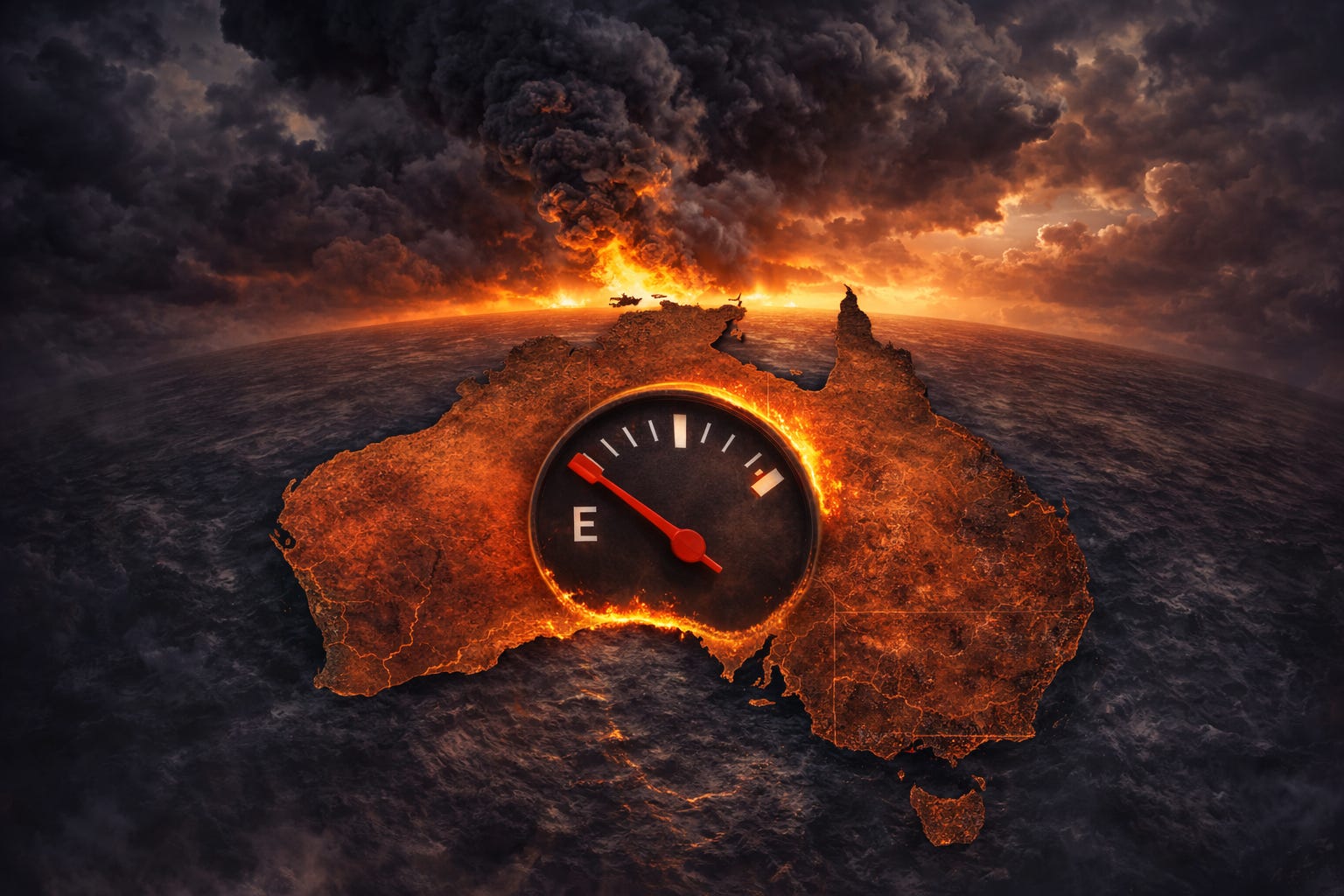
Australia is profoundly exposed. Decisions made in other nations will determine our fate because we have deliberately chosen to become an energy vassal.
As this column was going to print, China, Australia’s biggest supplier of aviation fuel, has told oil refiners to halt exports. One thing is certain, countries will act in their own self interest.
Repeating the point that we live on an island, and these risks are obvious, surely we stockpile fuel? We do and the numbers are reported in the government’s minimum stockholding obligations. The last readout says we have 36 days’ worth of petrol, 32 of diesel and 29 days of jet fuel. This is a vanishingly small amount in reserve.
The world is now being reminded that the International Energy Agency was created after the oil shock of 1973 and its primary task was to build a buffer against supply disruptions. Australia is one of the IEA member states that signed an agreement that required each to hold oil stocks equivalent to at least 90 days of net imports. Australia has been in breach of this agreement since 2012. This column has been banging on about this, in several venues, since 2016, clearly with no effect. All political parties are responsible for where we find ourselves today.
The stockpile system was designed to cushion the world against sudden supply disruptions by releasing oil into the market during a crisis. Stabilising supply also helps prevent the kind of price spikes that can tip the global economy into recession. That is why there will now be a co-ordinated release of fuel from the member countries.
Proper energy security is a deeper problem and one no Australian government has ever been serious about tackling. We might get lucky this time, but one day our luck will run out.
You do not need much imagination to conjure a scenario where our fuel lifeline of supplies from Asian refineries is cut. That trade comes through the South China Sea. What do we imagine will happen to those supply lines if there is ever a war over Taiwan?
The longer the world’s supply of fuel is choked, the more the pain will grow. It will be measured here in inflation, not just in fuel prices but in every piece of road freight. All we can do is hope that The Gulf war ends soon and that this crisis is enough to spark some real change in our leaders’ approach to energy security.
Right now, depending on the day, the price of oil and gas rises and falls on the musings about the war made by the American President.
Stung by the domestic price rises, Donald Trump has said he will call the conflict to an end soonish. Interesting that he believes he can turn wars on and off and that those he attacks have no say in the matter. What if the survivors of the Iranian regime have no interest in shouldering arms?
The end of the despotic medieval mullahs’ tyranny over its citizens is devoutly to be wished, but it seems unlikely. And while Trump’s war aims meander, the Iranian regime has one crystal-clear goal: survival. The hangman’s noose tends to concentrate the mind.
If the only way Iran’s mullahs can inflict real pain on the US and the rest of the West is to push the globe into a recession, that is what they will do.
They can also focus all of their effort on a strait that lies just off their coast and is only about 33km wide at its narrowest point, with tanker traffic confined to shipping lanes about 3km wide in each direction. They do not even have to sink ships. The trade stopped when war risk insurance disappeared and tanker owners refused to sail.
Trump says the US will underwrite insurance and lead convoys with warships. If form is any guide that service will not come cheap. It is also doubtful he will want any Australian sailors on board.
This article was first published in The Australian
Didn't you hear the most senior labour woman Tanya P say all we had to do was use more electric vehicles?
Our farm runs 4 diesel Ute's for 4 men and 1 tractor, currently mainly trying to feed and pump water every day for cattle and sheep during this drought in southern NSW.
3 days ago my brother tried to order another 1000 l of diesel as we always do, but was told he might have to wait up to a month for our delivery.
What do we do?
What a moronically stupid govt we have in Canberra!
Thank you Chris,
This was more than an essay on Australia’s energy predicament - it was a master class!
Australia was sold the green fairytale by successive governments and grifters… not forgetting the ABC and its cheerleading role.
But, unfortunately, I fear that the only thing that will snap us out of this delusional is a cold, hard recession. At the end of the day, physics will win because energy is more than wealth, ‘energy is life’ (Doomberg).