

From Here to Eternity
Memory, identity, and the politics of forgetting

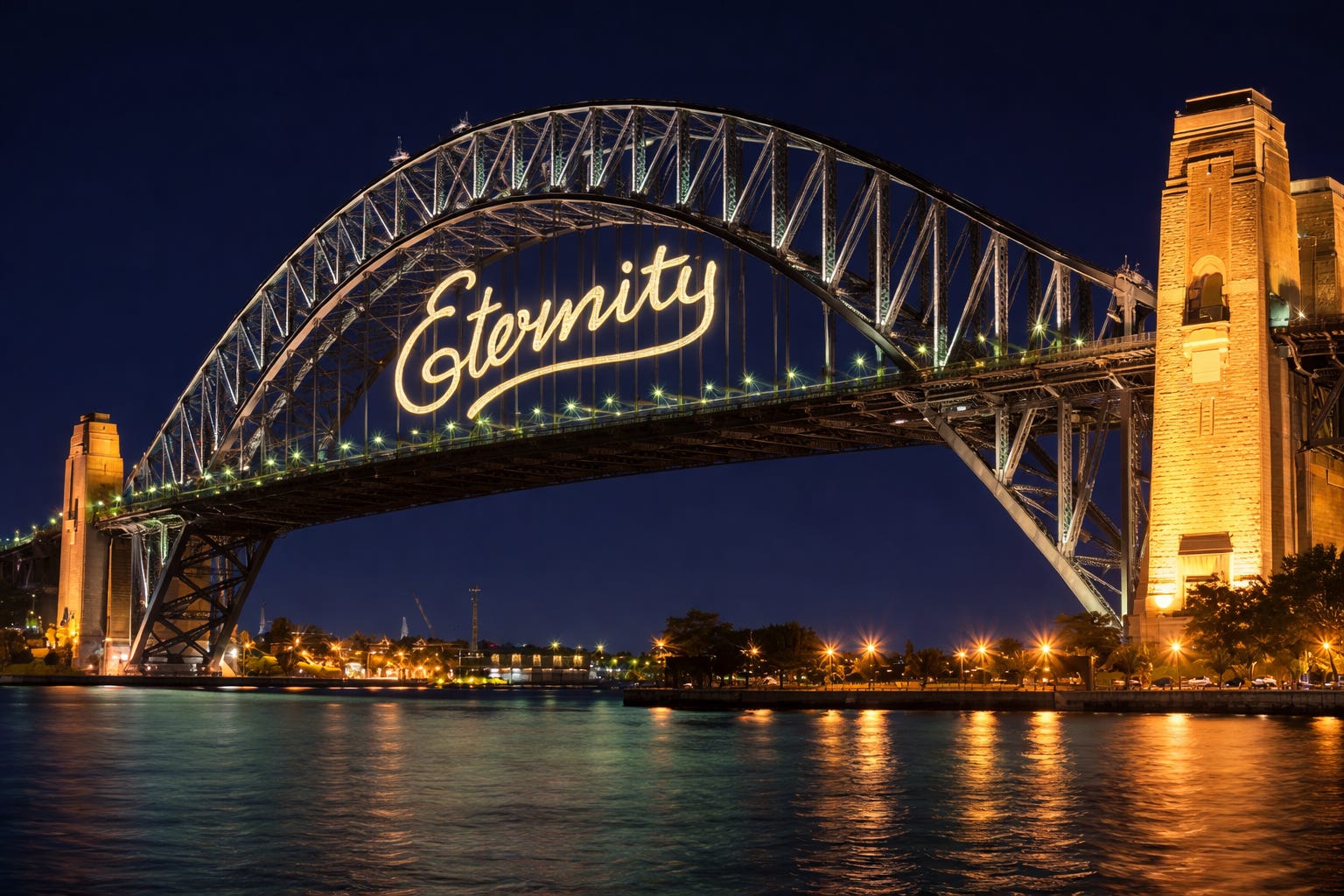
The childhood memory may be unreliable but it is vivid: a chalk inscription of a single word slashed on the pavement in Sydney – Eternity.
Our family was usually a long way from Sydney in the 1960s, traversing the country following my soldier father’s postings. But between 1964 and 1966 we were within striking distance, living on the outskirts of a then embryonic Canberra, just a five-hour drive from the Emerald City along an old Hume Highway that used to weave through every town.
My maternal grandmother lived in a Housing Commission home in Malabar on the edge of the eastern suburbs and we visited her twice: once to go to the Royal Easter Show and once for Christmas. We made several journeys into the city on green and cream double-decker buses.
Everything in Sydney seemed big, brash and vibrant. On one of those trips, I recall Nanna drawing our attention to the word Eternity chalked in fading, fluid copperplate on the pavement and passing on the lore that no one knew who the mysterious draftsman was or why he scrawled this one word everywhere.
We do now. Illiterate reformed alcoholic and World War I veteran Arthur Stace converted to Christianity in the 1930s and spent the next 35 years writing the same word on walls and pavement in the hope that passers-by would turn their thoughts to heaven. Prosecuted in his day for defacing property, he was celebrated at the 2000 Olympics when Eternity lit up the Sydney Harbour Bridge.
Stace’s Sydney and the mark he left on it are long gone, eroded by the ruthless footfall of time.
These memories of an exciting, optimistic and vanished Australia came flooding back on Ash Wednesday. The news was awash with stories about Ramadan and the Chinese Lunar New Year while Lent barely rated a mention. All three of these events move with the moon, and surely this rare convergence was noteworthy.
Anthony Albanese, had posted a video for the Chinese Lunar New Year and released a statement to mark the beginning of Ramadan. Again, there was no word about Lent from our culturally Catholic leader. Perhaps he had boned up on the scripture readings of the day, which cautioned against pompous displays of piety. Perhaps he just forgot.
But forgetting, too, tells a story.
It is good that the Prime Minister offered his best wishes to the Chinese and Muslim Australian communities, but surely the most important season on the Christian calendar also rates a mention. It is the tolerance of the Western tradition we inherit, with its deep roots in Judeo-Christian beliefs, that allows all faiths, and none, to flourish here.
You can over-read these things, but it is easy to place this wilful forgetting within the canon of a creed that deems white settlement an irredeemable stain on the national soul. Yet the fault is not shared. The burden of guilt falls only on what we might call, borrowing an old colonial insult, the currency lads and lasses. These locally born children of settlers were seen as lesser beings than the British-born “sterling”. The crime of dispossession is thus laid solely at the feet of the descendants of the various waves of largely British, pre-World War II settlers. Later migrants enjoy a kind of automatic absolution, despite sharing fully in the benefits of colonisation.
This dismal doctrine of hereditary sin pervades our academic, bureaucratic and cultural institutions and stains our national discourse. It is a joyless, nihilistic cult with a discipline of endless penitence that is robbing us of hope. A once optimistic Australia seems trapped in a permanent Lent with no promise of Easter.
This caricature of our history is deeply damaging and our national story is sorely in need of resurrection. Former prime minister Tony Abbott has done the nation a great service in producing his short history of Australia, which does not shy away from the stains on our past but does seek to reclaim the good in it. And there is much good.
It is past time to redeem the stories and storytellers of the currency lads and lasses who built one of the fairest and freest nations on Earth. Among those storytellers was journalist and poet Kenneth Slessor. There is no one working in the media today who matches Slessor’s gift with words.
He was highly cultured, steeped in literature, and loved Sydney, warts and all. Save for a couple of “vexing intervals”, Slessor lived on the margins of Kings Cross for 40 years, with the harbour “never out of my window”. In a poem on the hidden virtues of a seedy William Street, his refrain is, “You find this ugly, I find it lovely.”
In an essay on the city he wrote: “The character and the life of Sydney are shaped continually and imperceptibly by the fingers of the Harbour, groping across the piers and jetties, clutching deeply into the hills, the water dyed a whole paint box’s armoury with every breath of air, every shift of light or shade, according to the tide, the clock, the weather and the state of the moon. The water is like silk, like pewter, like blood, like a leopard’s skin, and occasionally, merely like water.”
The harbour looms large and foreboding in his masterpiece Five Bells. The poem meditates on time and the death of his friend Joe Lynch, a tall, gaunt, red-headed “mad” Irish cartoonist.
One rainy Saturday night, Slessor and Lynch heard there was a party in Mosman and jumped on a ferry. Lynch had his coat pockets stuffed full of beer bottles and, when the wake of a big liner hit, Joe fell into the water near where the Sydney Opera House now stands and drowned. His body was never recovered.
In Five Bells, Slessor says time “moved by little fidget wheels is not my Time”. He recalls when time on the harbour was measured by the tolling of ships’ bells and says he has lived many lives, including this one life “Of Joe, long dead, who lives between five bells”.
He is haunted by the memory of his friend, who has gone from earth, “Gone even from the meaning of a name”.
“Yet something’s there, yet something forms its lips
“And hits and cries against the ports of space,
“Beating their sides to make its fury heard.”
I remember a lunch with renowned Australian artist John Olsen who, even in his 80s, radiated delight as he retold the story of discovering Five Bells and of finding an ageing Slessor playing pool at the Sydney Journalists’ Club. The poet and his poem inspired the mural Olsen was commissioned to create, which now sweeps across the Northern Foyer wall of the Sydney Opera House. An echo of Joe Lynch can be heard there.
The poet and the artist are both dead. The old Journalists’ Club is long gone. But their stories remain, for those who care to look.
Memory is a strange custodian. It preserves, it disturbs, it distorts, softens and erases. Without actively working to protect memories, they can fade, and a nation’s understanding of itself can blur.
But forgetfulness is never neutral. If we do not reclaim our past, others will decide what is remembered. It falls to us to beat against the ports of space to make our story heard.
Or, like chalk on concrete, what was once vivid will vanish.
So beautifully written, I'm glad you are helping us remember what matters...
Brilliant piece Chris.
It used to be that, ‘history was written by the victors’ not the losers… but that’s where we are right now. ‘Hard times create strong men. Strong men create good times. Good times create weak men. And, weak men create hard times.’
Nothing new under the sun!