

Slippery Slope
Government spending sends Australia hurtling toward an inflationary abyss

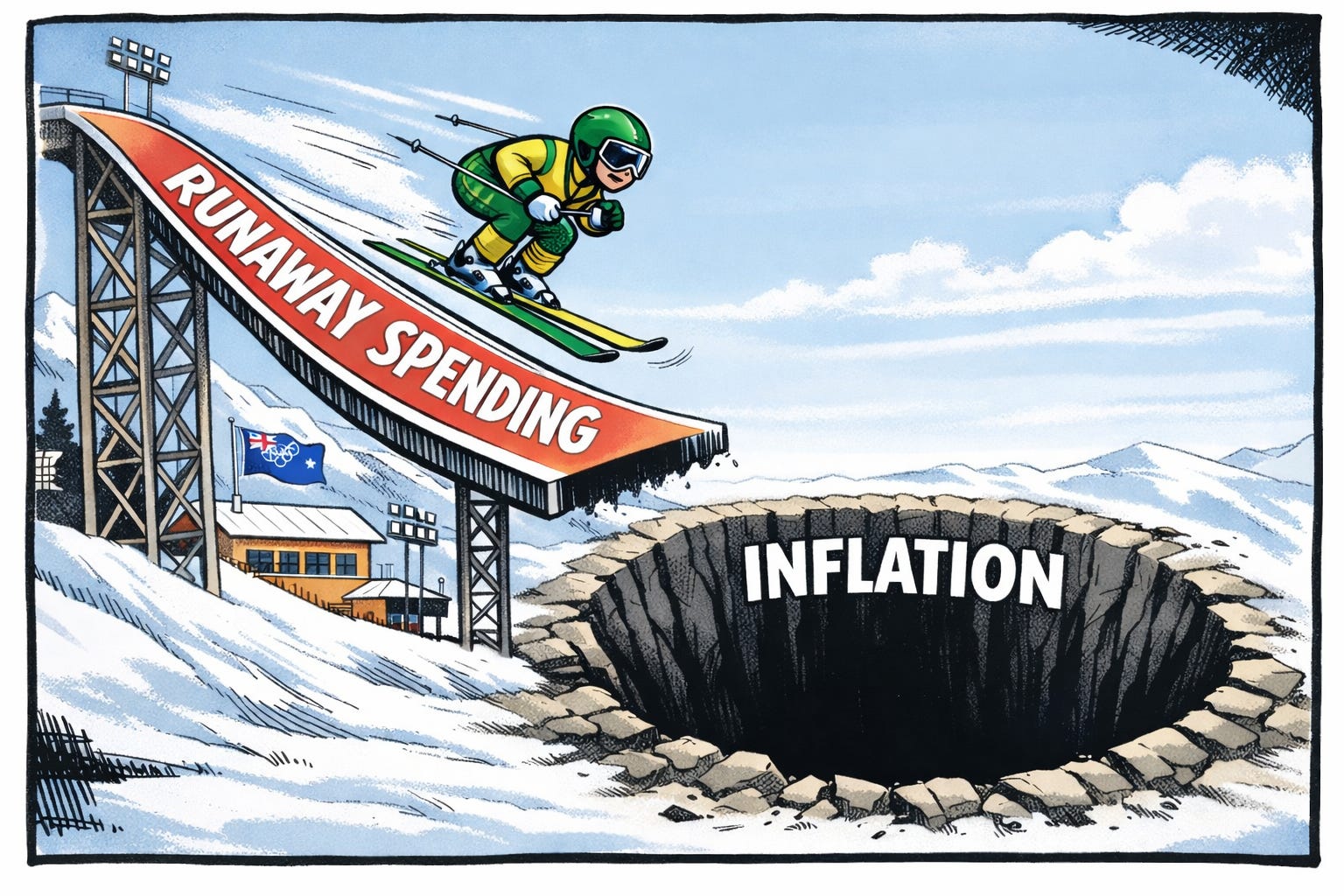
“There is little more infuriating to voters than to hear politicians tell them they have never had it so good when lived experience reflects the complete opposite.”
— Mike Newman
As a preamble, it is worth noting that the recent 0.25 per cent rate hike marks the first time ever that the Reserve Bank of Australia (RBA) has been forced to raise rates after only three cuts since systematic inflation targeting was introduced in 1990. Headline inflation is now set to rise to 4.2 per cent by June 2026.
Treasurer Jim Chalmers gaslit the public in typical fashion, blaming everything else for inflation. Never mind. He assured we minions that his government understands the pressure of rising interest rates on families and businesses. Damn that evil private sector demand driving inflation and forcing the RBA’s hand to initiate a 25-basis-point rate hike.
Even after Reserve Bank Governor Michele Bullock linked government spending to inflation, the Treasurer dug in over the weekend, claiming “public demand was making a smaller contribution, private demand a bigger contribution” to rising prices.
It just wouldn’t be cricket to accept that his government’s spending is out of control. Over the past two years, Labor’s budgets have blown out to an all-time record of almost $100 billion. Hardly a rounding error. We do not need to dig too deep to discover gross mismanagement. Did the Treasurer forget that multiple federal departments were recently exposed for exceeding staffing budgets by $841 million in 2024–25?
Has it escaped Dr Chalmers’ attention that 21,000 new federal recruits (+5.6 per cent), coupled with average public-sector salaries costing an extra $3.54 billion per annum (+9.5 per cent more than in 2023–24), are adding fuel to the inflation fire? The total wage bill for federal government employees is now $41 billion—almost double the level before the pandemic. Nothing to see here.
Still, Labor politicians took the opportunity to heckle, scoff and jeer at the fractured opposition in parliament on February 3 instead of showing contrition for incompetent economic stewardship. Only the Coalition’s disarray could have managed to steal the limelight and allow Labor off the hook over such a disastrous state of affairs.
The factors behind inflation are not rocket science. Chief among them is energy. Energy prices jumped 21.5 per cent annualised in the fourth quarter of 2025. This impacts every input—from farming, transport and refrigeration to simply turning on the lights or the air-conditioning.
The Treasurer continues to indulge Energy Minister Chris Bowen, who regularly celebrates the success of his 200,000-plus home battery program. Never mind that the $2 billion originally slated for the scheme has blown out five-fold to $12 billion. That’s right: those who can afford home batteries are being subsidised by those who can’t. You cannot make this stuff up.
Focusing on cost of living for families?
Those with $1 million mortgages will be on the hook for another $1,800 per annum due to the interest-rate hike. If Dr Chalmers truly understands voter “pain”, why, on February 1, did he sneak in fuel and alcohol tax hikes if his aim is to assist battlers struggling to make ends meet?
Labor might argue it is committed to rolling out more “cost-of-living” relief, but that always equates to more of our own money raised through higher taxes, then recycled back to bail us out of problems we should never have been in if we had sensible energy policies.
The latest annual report from the Australian Energy Regulator (AER) reveals that average energy debt across residential customers suffering from energy poverty is up 19 per cent ($1,367) on 2024 levels, despite bill-relief rebates.
By the AER’s numbers, in 2020–21 there were 182,655 households in energy debt. In 2024–25, that figure has almost doubled to 336,615 households. Of the 122,000 households on official hardship programs, almost 40 per cent have been on them for more than a year. Of the 150,000 that exited the programs, 64.6 per cent were discontinued because households failed to meet agreed payment plans. For the cost of the Voice referendum, Labor could have paid off the $450 million in outstanding residential energy debt that exists today.
Switching to business
The impact of energy prices has hurt small businesses too. Average energy debt for businesses reached $2,516 in 2024–25, 40 per cent higher than in 2022. There are now 45,000 companies in energy debt over the same period—28 per cent more than when Labor took office.
Perhaps if the Treasurer truly grasped the corporate drivers of financial markets, he would understand that businesses do not invest solely on the basis of low interest rates. They invest because they can see the cycle ahead. Therein lies the problem. Australian companies cannot see favourable winds because of onerous regulatory frameworks. Why does a café in Victoria need 37 licences to open?
Net private business investment as a share of GDP languishes at just over 12 per cent—levels last seen around the severe 1990s recession. A decade ago, it sat comfortably between 14 and 18 per cent. Put another way, private enterprise sees mounting challenges because productivity growth has become so anaemic that the economy is red-lining and overheating at a puny 2 per cent.
If the private sector is driving inflation, why has the Australian Securities & Investments Commission recorded 14,722 insolvencies in 2024–25? Perhaps the Treasurer and Housing Minister Clare O’Neil—when she is not debating Senator Murray Watt on social media about the ranking of böreks, jam doughnuts and cinnamon rolls—can explain why 9,500 construction companies have collapsed since 2022, a 79 per cent jump since Labor won office. Why is almost 50 per cent of the cost of building a house now accounted for by government regulation and taxes?
This government’s obsession with spending and taxing more lies at the heart of the problem. Here is an idea: cut red tape. Reduce approval times. Consider an investor waiting up to 10 years for approval while simultaneously weighing capital allocation decisions. If that timeframe were reduced to 18 months, government would not need to spend a cent. Attractive policy settings would drive investment through ease of doing business. The departments advising ministers simply do not understand business—hardly surprising when the average tenure of top public servants is 28 years.
Not much hope overseas either
Having just returned from an overseas visit with a client, the prognosis is bleak. When government is indirectly told by a reputable third party that senior executives within the ministry of a major trading partner are “developing an Australian allergy”, one would hope this would trigger urgent self-reflection.
Instead, when investor feedback that “confidence is falling” was relayed to diplomatic outposts, the response was that the bilateral relationship has never been better. Officials pointed to regular consultations as proof. This carries about as much sincerity as telling a five-year-old that his favourite Tonka dump truck will be placed on a higher shelf—visible but out of reach—to encourage him to play with more climate-appropriate toys.
In any private business, damning feedback is treated not just as a warning but as an opportunity to fix problems quickly. Failure to do so risks lost profitability—or worse, collapse.
More disturbing was unsolicited commentary during a roundtable discussion. One trading outpost is actively pushing overseas investors to participate in smelting opportunities, especially those with green credentials. Forgive the confusion, but isn’t the government already spending billions to subsidise the survival—under the banner of energy transition—of once-profitable fossil-fuel-powered smelters such as Mount Isa Copper in Queensland, Tomago Aluminium Corporation in New South Wales, Nyrstar Port Pirie in South Australia, and Hobart Zinc in Tasmania?
Dig deeper and the futility becomes clear. Tomago is the largest electricity user in NSW, with a 904-megawatt peak load, consuming the equivalent of the entire Australian Capital Territory’s annual electricity use. Energy accounts for 40 per cent of its operating costs. Aluminium smelting requires temperatures of around 950°C during electrolysis. Due to grid instability, Tomago warned regulators almost a decade ago that while it could manage load-shedding with one hour’s notice, “catastrophic potline freezing” would occur if outages extended beyond three hours. In a 2017 letter to the NSW Energy Security Taskforce, Tomago stressed that “the early demise of baseload power generation only pushes up energy prices and represents a significant risk to the long-term viability of the smelter.” Climate zealotry has created precisely these conditions. Embarrassingly, taxpayers are now being used to flog a dead horse.
None of this is new. International investors across multiple industries continue to warn that Australia’s energy prices are simply too high to support competitive manufacturing. Add new workplace laws, productivity at six-decade lows, glacial approval processes, and investment-attractiveness scores worse than Zimbabwe, the Democratic Republic of Congo or Ivory Coast—and the mess becomes obvious.
Inflation is a problem. But inflated egos inside a party bathing in its own hubris have nemesis written all over them.
 | A guest post by
|
This is a good summation of many problems. I would add though that any analysis has to accept that the Labor Party (with the Coalition being unaware bedfellows) have created a captive class of rent seekers who are reliant on government largesse to fund their lifestyles and will vote accordingly. This is true for the public sector, as it is true for selective private sector enterprises where the spigot of never-ceasing public financing is the only thing that keeps their lights on. In effect, there is an element where Labor rewards their friends in these industries by punishing their enemies in the productive part of the private sector.
The Coalition are no different and are worse insofar as their are totally unaware of how State capture works. One reason why the Coalition in power feels like a slightly crankier version of Labor is because they broadly follow the same prescription of giving money out to preferred private and public sector voter groups. As the quality of politicians and public servants steadily declines and the quality of the rent-seekers on the other side of the equation grows, the productive side of the Australian economy is continually squeezed (or more migrants are let in acting as a form of diminishing marginal returns on the sugar rush of a larger domestic market) and the more the overall state of the economy declines.
Very good piece. Also, just imagine what the inflation rate would look like if they included mortgage interest payments, share prices, income tax, HECS repayments, stamp duty, as well as the other items that they exclude or "trim" to manipulatime the data.
Australia in big trouble.