

The State vs the People
Australia’s bureaucracy believes targets trump physics — we will all pay the price

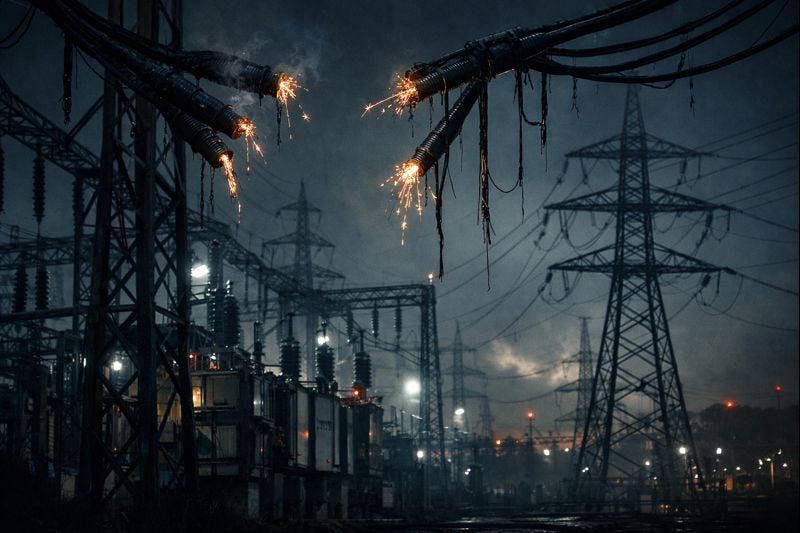
Australia’s agencies of state have become a danger to the Commonwealth. Instead of acting as a handbrake on bad ideas, they share the delusion that government fiats on energy can override physics, conjure cheap power and invent new industries.
These institutions inhabit a model world, where real-world hikes in retail power bills, the hollowing-out of industry and the growing risk of blackouts are dismissed as trivial, anecdotal or transient. Evidence is an inconvenience to be explained away as bureaucrats recast themselves as co-authors of a modern morality play.
Worse, the blizzard of government publications produced in 2025 does not even cohere into a single, consistent whole. A survey of the past year’s documents on the energy transition, churned out by some of the world’s highest-paid bureaucrats, delivers a cacophony of confusion. Outdated information is embedded in new advice, assumptions grow ever more heroic, and mantras masquerade as policy.
The essential purpose of the grid, delivering secure, reliable and affordable power, has been relegated in pursuit of the ideological goal of cutting carbon emissions. Once the core function of a system is perverted, everything that depends on it begins to fail. Prices rise and reliability erodes as policy drifts into fantasy, sustained by the conviction that everything is justified by the cause of saving the planet.
The architects of this disaster appear not to understand that they are conducting surgery on the nation’s central nervous system. Get this wrong and the damage is catastrophic and permanent. And this is only the beginning: electricity is merely the first stop on the road to a much broader and more destructive dismantling of the energy system.
This is not a dispute about climate change or the demand to cut emissions. It is about whether the Australian state understands the physical system it is attempting to command, and whether it grasps that what it is doing will depower the economy, drive up costs across the board and place the nation on a path to poverty.
Study last year’s blizzard of official advice underpinning Australia’s emissions target and it is littered with glaring errors, deliberate sins of omission and fragmentation, as old assumptions are preferred over real-world limitations.
Start with the Australian Energy Market Operator. AEMO’s Integrated System Plans are the sacred text on which the mantra of the “least-cost” path to a decarbonised grid rests. Let’s be clear, these documents are explicitly about hitting government-decreed carbon-cutting targets, not delivering cheap, abundant energy. The 2024 ISP assumed rapid coal exit, an unprecedented build-out of renewables, firming and transmission, and smooth delivery across multiple states. Ministers cite it. Regulators lean on it. Every other agency inherits it.
Then, in August last year, AEMO began rewriting it.
In its Electricity Network Options report, AEMO admitted that transmission costs had surged, in some cases by up to 100 per cent, driven by supply-chain constraints, labour shortages, project complexity, social-licence issues and rising contracting risk.
It made this admission:
“AEMO recognises that increases in costs for electricity transmission network development would impact bills for electricity consumers.”
The message was clear: the 2024 “optimal development path” was no longer reliable and would be rewritten in the 2026 draft Integrated System Plan. That should have triggered a pause across government. Instead, the machine chugged on as it prepared for the September release of the 2035 emissions target.
The Climate Change Authority’s advice that Australia should cut emissions by 62–70 per cent below 2005 levels by 2035 is explicitly anchored to the central scenario in AEMO’s 2024 ISP. That pathway assumes coal-fired generation largely exits the system by the late 2030s, and that replacement renewables, firming and transmission are delivered on time and at scale.
“Scaling up capacity in the National Electricity Market (NEM), including six-fold growth in utility storage, quadrupling wind capacity, tripling utility solar capacity and doubling rooftop and distributed solar capacity by 2035, consistent with the Australian Energy Market Operator’s (AEMO’s) Step Change scenario,” the report says.
But the Authority was leaning on a grid plan the system operator had already flagged for revision. When that revision arrived, in December’s draft 2026 ISP, coal’s exit was pushed back by a decade, with closures no longer smooth or front-loaded but slower, lumpier and far more dependent on announced retirements rather than modelling ambition. Transmission delivery was treated with greater caution. Workforce constraints, supply-chain delays, social-licence barriers and system-security risks were elevated from footnotes to central planning assumptions.
The certainty that underpinned the 2024 Step Change pathway, and on which the Authority based its advice, had evaporated. That is not a minor technical adjustment. It goes to the credibility of the entire advice chain on which the government’s 2035 target rests.
And, as Powerlines has pointed out in an earlier post, AEMO has yet to revise its outdated assumptions on worst-case wind droughts. The critical generation gap in the 2024 ISP was identified by Queensland-based Global Power Energy, a specialist consultancy whose 15-strong leadership team has more than 400 years of combined technical, regulatory and commercial experience across generators, networks and the market operator.
The eastern grid is being built on an AEMO model that assumes wind power will never fall below 14 per cent of capacity for multiple days. Yet a GPE study of the real-world 2024 autumn wind drought shows wind collapsing to roughly half that level during three separate week-long slumps, raising serious questions about whether a weather-dependent grid can keep the lights on.
When Treasury rolled out its modelling of the net-zero transition, it assumed decarbonisation of the electricity sector would proceed “consistent with recent trends and the (outdated) ISP”. It does warn that a disorderly transition would drive up wholesale prices and undermine investment. But the disorder it imagines is political. The disorder now confronting Australia is structural.
So Treasury is no longer stress-testing policy. It is amplifying error and manufacturing reassurance. And when the nation’s most important economic agency starts publishing comfort fiction for government instead of confronting reality, it betrays its heritage and the community it is meant to serve.
The headline act in this bureaucracy-wide institutional collapse came with the December 19 release of the Productivity Commission’s Orwellian-titled Investing in cheaper, cleaner energy and the net zero transformation. That demonstrably false slogan reveals the document for what it is: activism dressed up as economics.
The Productivity Commission was established to be a guardian of economic rationalism, providing governments with independent, evidence-based analysis to enhance productivity and economic welfare, not to act as a cheerleader for political objectives. Its legitimacy rested on its willingness to pull bad policy apart, test assumptions and champion markets.
All pretence of that evaporates here. The opening paragraph declares, without qualification, that “reducing emissions from greenhouse gases is an important national priority”. There it is: the cart of net-zero ideology placed firmly ahead of the horse of productivity.
From that point on, the conclusions are foregone. Markets are no longer trusted. Capital allocation is no longer disciplined by price signals. When the sole goal is to nail down a carbon target, everything is hit with the hammer of government intervention. An institution created to interrogate political ambition has instead absorbed it, transforming itself from devil’s advocate into preacher.
One recommendation is to accelerate the closure of coal-fired power stations by expanding and repurposing the Safeguard Mechanism, shifting from a sector-wide approach to facility-level emissions constraints, tightening the screws until coal generators are squeezed out, starting with brown coal in Victoria and moving on to black coal in NSW and Queensland.
This is not productivity reform. It is environmental activism by regulatory attrition.
The Commission claims faster decarbonisation will reduce the overall cost of the transition, while ignoring the constraints AEMO flags in its 2026 draft plan. It assumes gigawatts of reliable power can be conjured on demand and that the known risks of premature coal closure, price spikes, reliability failures and rising system-security costs, can be waved away.
The report’s superficiality is striking. It advocates a rapid build-out of renewables and transmission as markets struggle to meet existing targets. It favours large-scale wind even as private capital retreats due to rising costs, planning delays and community opposition.
Reliability is treated narrowly, with scant regard for system security. Coal closures require extensive stabilisation infrastructure, synchronous condensers with lead times of four to five years and price tags approaching $160 million each. Transgrid alone plans around ten in NSW by 2030. This barely registers in the Commission’s analysis.
The Commission also urges fast-tracking approvals by privileging the energy transition over biodiversity, heritage and community objections. It proposes a federal strike team and coordinator-general to bulldoze resistance. It calls for expanding the Safeguard Mechanism by lowering thresholds to 25,000 tonnes, dragging hundreds more businesses into carbon compliance.
More costs. More intervention. How does any of this improve productivity?
Now consider the reports from all these agencies alongside the draft 2026 ISP. What matters is not a single number but the tone. Where 2024 was confident, the draft is hedged and conditional. It flags workforce shortages, long lead times, higher costs, social-licence barriers and sequencing risk. Caveats multiply.
This is how engineers write when they are no longer confident the system can be bent to a timetable.
Politically and institutionally, however, the language has hardened. Targets are higher. Regulatory pressure is intensifying. The insistence that the transition will be “orderly” grows louder even as disorder spreads.
AEMO revises its assumptions. Other agencies build their case on the old ones. The Productivity Commission abandons markets in favour of coercion. Each institution amplifies error. Collectively, they appear to believe their policy prescriptions can dominate physics.
The only glue binding this together is ideology, the belief that net zero by 2050 is paramount and the real world will comply if pushed hard enough.
All this for what?
Australia produces around one per cent of global emissions. China produces roughly 30 per cent and continues building coal-fired power stations to guarantee energy security, industrial dominance and political stability. Coal is a strategic asset baked into China’s future.
Australia, meanwhile, is destabilising its electricity system, driving up costs and hollowing out energy-intensive industries. Next comes the push to torch the billions in export income that comes from coal and LNG in exchange for hypothetical green industries. Then we will impose more costs on transport and agriculture.
This is not climate leadership. It is unilateral economic disarmament and an act of deliberate self harm.
Reality will not bend to ideology. It never does. And the longer Canberra pretends otherwise, the higher the price Australians will pay, in bills, reliability and lost industrial capacity.
This is institutional betrayal.
As with the electricity system itself, the bureaucracy has lost sight of its purpose. Once that happens, everything that depends on it begins to fail. Agencies meant to test ideas, restrain excess and ground policy in reality have instead become ideological amplifiers. When the state forgets its obligations to the community, to security, prosperity and resilience, it ceases to be a steward of the Commonwealth and becomes a risk to it.
Another great article. I’d add that these agencies are unaccountable to anyone, and lack any governance and oversight. Time to reform the lot - and by that I really mean getting rid of them,
Until the Public Serpents are reigned in and controlled by those paying their bloated wages - we the people - they will continue to serve themselves and the highest paying masters of the Globalist blob.
"This is institutional betrayal."
Spot on. Also known as malfeasance in office. Or treason.
And if the majority do not fightback this will not change. If it is not soon it may be too late to recover and the lucky country will be a distant memory if it is not removed from history altogether.